An interview with Dr Mark Hawker, Business Intelligence Lead for MEDIO, powered by Involve.
In this blog post, Dr Mark discusses how a chance conversation about Informatics set him on a path he’d never planned, from a Masters and PhD at the Yorkshire Centre for Health Informatics to leading Business Intelligence (BI) within the Involve team. He also reflects on how the NHS’s relationship with data has transformed over his career, from decisions made on gut feel to a discipline in its own right, and how AI is now making it possible to connect data to patient benefit faster than ever before.
What got you into healthcare in the first place, and what’s your role now?
It started almost by accident. After sixth form, I was deciding what came next when a friend in the NHS mentioned Informatics: combining computer science, cognitive science and information technology to solve real healthcare problems. I was drawn to the idea of turning raw data into insight that could help patients and healthcare organisations make better decisions.
I studied Informatics at university, then joined the Yorkshire Centre for Health Informatics at the University of Leeds. A Masters became a PhD focused on healthcare technology adoption and use. Later, I moved into Airedale NHS Foundation Trust’s Information Services department, working on telemedicine projects including Immedicare. That work brought me closer to the Involve team and eventually led to my current role as Business Intelligence Lead.
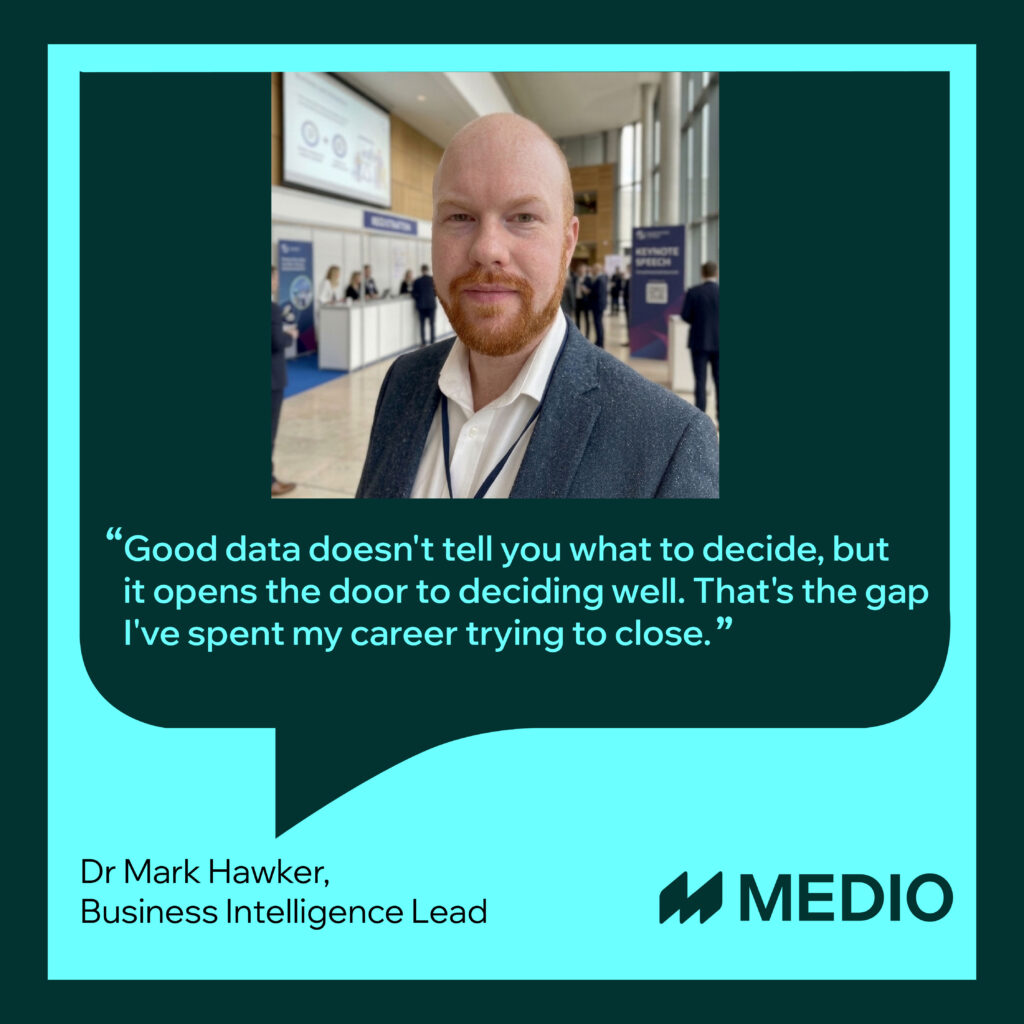
Looking back, it’s a path that’s really been shaped by one underlying idea: good data doesn’t tell you what to decide, but it opens the door to deciding well. That’s the gap I’ve spent my career trying to close.
Over the years you’ve been in the industry, how has healthcare’s relationship with data changed, what’s really shifted?
The biggest shift has been the professionalisation of data roles. When I started, data work in the NHS was often something people did alongside a clinical or administrative job. Now it is recognised as a discipline in its own right, with dedicated teams, clearer career pathways and more senior influence. Information departments have also moved from back-office reporting functions to genuine partners in decision-making.
National programmes such as Making Data Count have also encouraged a more thoughtful, standardised approach to presenting and using data. Technically, reporting has moved beyond simple red-amber-green ratings towards statistical process control and more sophisticated analysis, giving a clearer view of real change rather than background noise. More recently, AI has become a practical tool for supporting decisions now, not just a future possibility.
Ultimately, the value of better data is whether it improves care. Stronger data literacy, better tools and mature reporting help services see where pathways are underperforming or where demand is rising before it becomes a crisis. That means patients wait less, are seen sooner and receive more consistently safe care. The technology and professionalisation are the means; better outcomes are the point.
Was there a moment or realisation that made you think “we need a better way to bring all this data together”?
It was not one single lightbulb moment. It was a gradual realisation, reinforced every time I saw decisions being made on gut feel because useful information was not available in the moment it mattered. The data often existed somewhere, but not in a form people could act on. That matters because a decision based on guesswork can ultimately shape a patient’s care.
What spurred me on was hearing how colleagues used the dashboards and reports I was building. When a report changed a conversation, or a dashboard gave someone the confidence to make a decision, it showed me this was not just about producing outputs. It was about giving people evidence they could act on, and making sure those decisions served patients better.
AI has changed the equation again. Bringing data together across organisations, once a hard and resource-heavy problem, is now far more attainable. That makes it possible to connect data to patient benefit faster and more reliably. My sense that we need a better way to do this has not gone away; it has evolved with what is now possible.
Can you explain what MEDIO Pro is, and what it lets clients see and do that they couldn’t before?
MEDIO Pro gives healthcare clients the information and support they need to make better decisions about the care and services they deliver. It helps them understand how health technology is being used, what clinical and operational impact it is having, and where further support may be needed. It is more than reporting: it is a professional services wraparound covering technical design, installation, adoption support, customer success, and BI dashboards.
In practice, healthcare organisations are not simply handed a system and left to work out whether it is being adopted or improving care. The BI reports and dashboards show how a service is performing, where teams are using the technology well, and where adoption or pathway efficiency can improve. That shifts the conversation from “we installed health technology” to “here is the evidence of the difference it is making to care.”
What’s been the most rewarding part of watching clients actually use it? Are there any moments that stood out?
Our work with the Health Service Executive has been particularly rewarding. Through the MEDIO Pro partnership, we have worked closely with clinical and operational teams to develop dashboards that show the value of the services we provide: where they are working well for staff and patients, and where there is room to improve.
What stands out is seeing that intelligence used where it matters. It is not just a reporting exercise; it has become a tool the HSE relies on to guide management decisions about how they deploy and use our services. That is what MEDIO Pro is designed to achieve: an ongoing partnership where insight keeps proving its value long after go-live, helping organisations make better decisions for patients.
Get in touch with Dr Mark and the MEDIO team at: hello@involve.vc